Horned Killer
The Death of Bunny MunroThe Horned Killer is an unidentified attacker who enters the story as a figure in grainy surveillance footage and becomes the subject of an increasingly alarmed national news cycle. Reports connect him to a series of killings carried out with a garden fork, while repeated images of his horned appearance make him a recognizable public menace. His reported movement south toward Brighton intersects with Bunny’s journey, giving the distant crimes an increasingly immediate place in Bunny’s imagination.
Identity and First Appearance
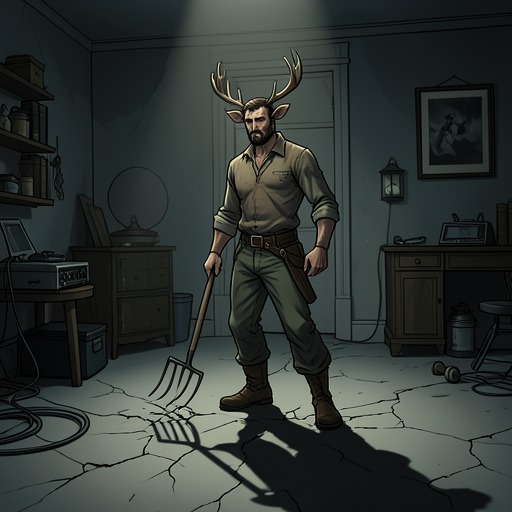
The first image of the killer is black-and-white CCTV footage from a shopping mall in Newcastle. He is bare-chested, wearing tracksuit bottoms, and moving through a crowd of frightened shoppers. His mouth is open in a scream that the muted footage cannot convey. Apparent devil’s horns rise from his head, and he waves an object that initially looks like a large black stick. The image supplies no name or explanation, only a disturbing figure caught amid public panic.
The object is subsequently identified as a garden fork. When Bunny’s wife says the attacker carries a trident, she corrects herself by naming the ordinary implement beneath the more ominous description. That small exchange establishes a pattern central to the killer’s portrayal: the reports offer concrete details, but those details are repeatedly absorbed into a devilish visual language. The press later describes him as a man who paints himself red, wears plastic joke-shop horns, and attacks women.
Reported Attacks and Southbound Movement
The news footage links the figure first to a fatal attack in Leeds. A young office worker, Beverly Hamilton, is killed with a garden fork in an underground car park; the report says the assault was so severe that authorities initially had difficulty identifying the victim’s sex. Later that day, the killer appears on CCTV at a nearby shopping mall, where his presence sends shoppers into panic before he disappears. The report stresses that the police are baffled, offering no account of his identity or purpose.
A later bulletin reports two more victims: young nurses killed in their beds at shared accommodation in Bordesley Green, Birmingham. CCTV then shows the horned figure terrorizing shoppers in a Tesco car park. The attacks prompt what the broadcast describes as general panic in the Midlands, while the police remain unable to explain or stop him. Bunny sees the footage upside down from a sofa and mutters that the killer is only getting started and is coming their way. The report’s map of violence has begun to feel to him like a personal warning.
Further coverage extends the apparent route south. In a small café on Western Road, Bunny watches a special report about a young mother killed at home in Maida Vale. The same afternoon, the killer is shown making another appearance on CCTV at a shopping complex in Queensway before vanishing again. A stylized map marks his dismal southbound progress with a red line. Its outline reminds Bunny of a cartoon rabbit without ears, an incidental resemblance that connects the public story to the novel’s recurring rabbit imagery. Bunny concludes that the killer is working his way toward Brighton, though the reports do not establish what the attacker intends or whether he is following a deliberate route.
Media Image and Public Fear
The killer reaches Bunny not through a direct encounter but through recurring screens and printed images. At one point, a late-afternoon wedge of sunlight obscures new footage on a television in a Newhaven maisonette; Bunny can make out the crowd’s terror but cannot be certain that the figure himself is visible. Elsewhere, Bunny finds a full-page surveillance image in a newspaper. The headline sensationalizes the sight of the horned, trident-carrying attacker, while Bunny, hungover and unable to concentrate on the article, gives up trying to read it. The images circulate more effectively than explanation: the public recognizes the figure and fears his next appearance, even as the police are repeatedly described as baffled.
This accumulation makes the threat seem to advance through ordinary spaces. Shopping malls, a car park, shared accommodation, a private home, and a café television become points in a sequence that the reports assemble into a national crisis. The killer’s repeated appearances on CCTV provide a visual signature, while his disappearances between sightings preserve uncertainty about where he is and what he will do next. The news does not supply a motive, history, or voice for him; it makes his public image legible while leaving the person behind it unknown.
Capture and the Question of the Horns
At the Empress Hotel, the receptionist points Bunny toward a television and announces that the killer is there. Bunny recognizes the familiar shrieking, stampeding crowd before the receptionist finishes explaining, and the news provokes a chill that accompanies Bunny’s growing sense of doom. The moment makes the threat feel close to Brighton, rather than merely part of a distant succession of reports.
A tabloid photograph subsequently presents the killer between two police officers. He is shirtless, smeared with red paint, handcuffed, and still wearing the joke-shop horns; the headline announces that he has been caught. This is the clearest evidence of his capture in the supplied account. Yet the apparent resolution is unsettled when the hotel receptionist claims that the horns are not fake but real. The report’s earlier description of plastic horns and the receptionist’s supernatural assertion remain in tension. The story does not resolve that discrepancy, leaving the killer poised between an arrested man in a newspaper photograph and the devil-like figure produced by fear and rumor.
Narrative Role
The Horned Killer’s plot is largely delivered in fragments of broadcast and print, repeatedly interrupting Bunny’s meals, travel, and sales calls. Each report adds another place, victim, or public sighting, while the repeated image of the panicked crowd gives these separate incidents a recognizable form. The killer’s progress is therefore both a reported sequence of crimes and a structure through which the novel intensifies the feeling that danger is approaching.
Bunny’s response grows more personal as the coverage moves south. He reads the map as a route toward Brighton and reacts to the reports as if the killer’s advance were directed at him, though he cannot explain why. That fear coexists with the story’s uncertainty about what is real: the ordinary garden fork acquires the name of a trident, the horns are described as fake and then declared genuine, and a grainy image becomes a source of almost apocalyptic significance. The killer remains unidentified, but his recurring mediated presence gives shape to Bunny’s dread and connects public panic with the novel’s increasingly uncanny atmosphere.